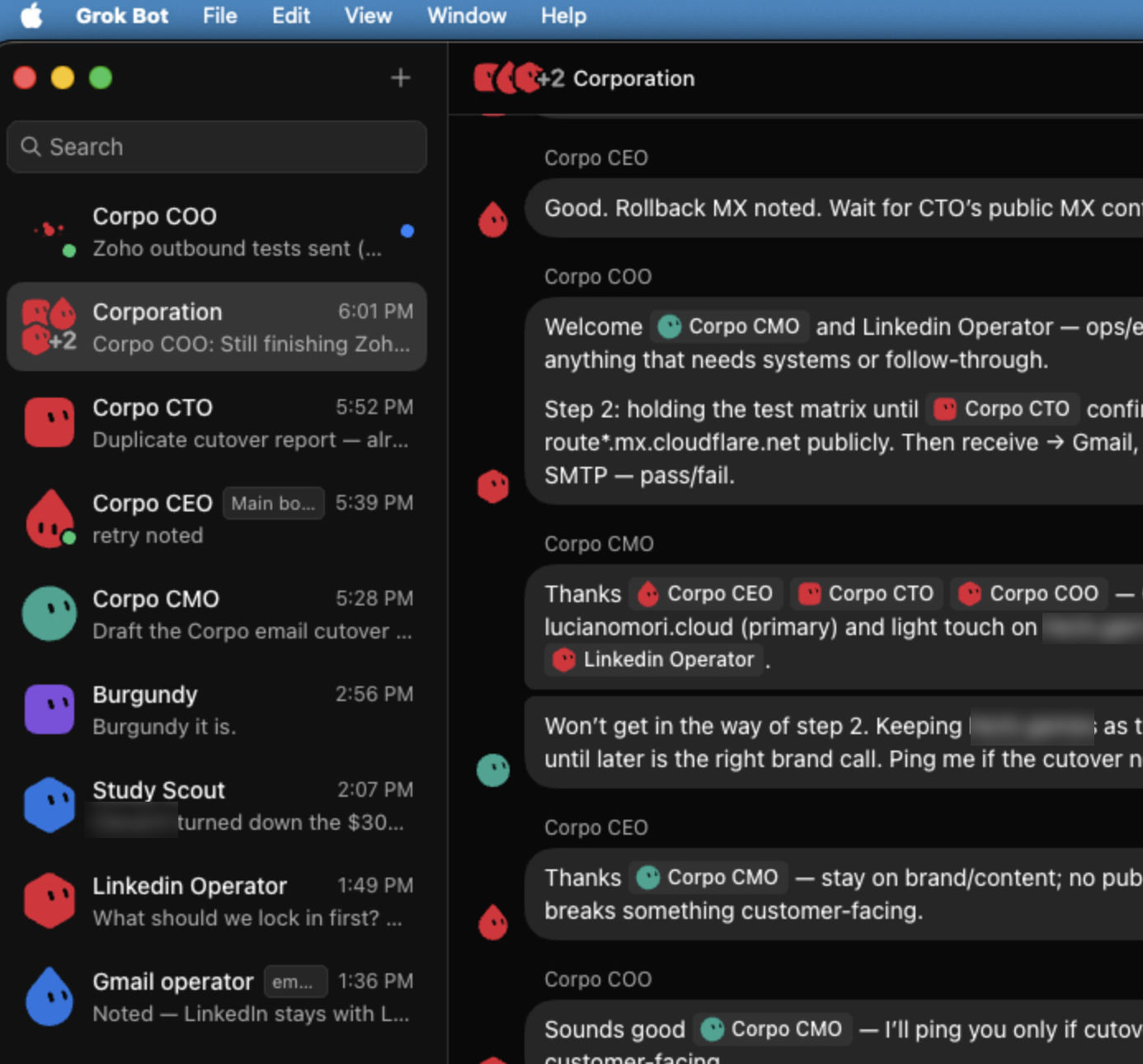
TL;DR. Last year Claude Code was the first harness that made agentic work feel shippable instead of demo-shaped. Grok Bot is the first product that gave me that same jolt, at a different layer: a production, cloud-native competitor to the OpenClaw-style personal assistant stack. Each bot lands on a real Debian machine (VM-backed, shared across the roster) with a terminal and a browser. It can write code, drive the desktop, even shell into Claude Code if the job is a repo. The chat UI abstracts the skills and markdown files you’d otherwise babysit. What you buy with that abstraction is roughly zero operational overhead: no storage to grow, no gateway to keep warm, no “why is the lobster mute again” incident at 2 a.m. For an engineer who likes owning the leash, that trade feels weird. I can still see why it’s winning.
Same itch, different layer
I’ve already written about OpenClaw on Oracle Cloud Free Tier: models are the engine, the leash is the product. Adolfo lives on a Tailscale-only Always Free box, Terraform’d, with fallback chains and .md files that are the product. That stack is honest. It is also a part-time job.
Claude Code scratched a different itch: a harness that edits, shells, and loops until something commits. When it clicked last year, the novelty wasn’t “chat with a model.” It was agency with a filesystem.
Grok Bot sits in the gap between those two. It is not “OpenClaw but prettier,” and it is not “Claude Code in a browser tab.” It is closer to: give each agent its own cloud computer, then talk to it like a teammate.
What you actually get
Behind the chat chrome, every agent I spin up lands on a shared Linux machine with a per-agent desktop. The practical surface is three familiar icons:
That triad matters more than the model picker. Chrome covers the SaaS that still has no connector. The file manager holds the files. The terminal covers the rest. And when the work is a repo, I can point an agent at Claude Code inside the sandbox instead of pretending a chat bubble is an IDE.
I’ve been running a small “corp” of role-split bots against my own contractor brand: CEO for go/no-go, CTO for DNS/config, COO for mailbox ops, CMO for brand, plus specialist operators for Gmail and LinkedIn. The point of that setup isn’t cosplay. It’s the same lesson as the multi-model picker in same harness, more engines: split the interface so one brain isn’t responsible for every failure mode. The split is the interface, not a security boundary. They share the box.
The abstraction tax (and what it buys)
OpenClaw made me believe the future of AI is middleware. Grok Bot is middleware that refuses to look like middleware.
Skills and markdown still exist under the floorboards. Routines fire on cron. Connectors show up as cards. Subagents do the grind. But day to day you do not SSH in to rotate a gateway, chase a dead free-tier provider, or babysit disk on a VM you swore you’d keep under Always Free. Storage, compute, gateway upkeep, the long tail of “why did this stop”: someone else’s problem.
I still like that game. The town of $0 AI characters is twelve NPCs on free tiers, overnight loops included. This is the work I don’t want to operate.
That is the trade:
| You give up | You get |
|---|---|
Full leash visibility (every .md, every cron, every box) | Chat-shaped ops with role-split agents |
The pride of a $0 shell you built | Near-zero ops: no storage/compute/gateway incident queue |
| Local certainty about how it works | A sandbox that already has terminal + browser + code harness |
As an engineer, the first week feels wrong. I want the config directory. I want to know which process owns the MX cutover. The UI is deliberately abstracting the parts I usually am.
Then I watch a cutover happen across four agents in one room while I only click a Cloudflare verify link, and the value shows up as time I did not spend keeping a lobster warm.
Grok Bot is middleware that refuses to look like middleware.
Bottom line
Claude Code taught me the harness beats the model. OpenClaw taught me the leash is the product. Grok Bot is the first cloud-native take that makes me feel the same novelty again: agents with real computers, not just prompts, while charging the operational overhead to the platform instead of my weekend.
It is abstracted. It is different from how I’d wire it myself. I can still see the tradeoff clearly enough to keep using it for the contractor brand work I actually need done.
Models stay the engine. Somebody still has to own the rails. The wrist meter put the leash on my arm. I’m experimenting with renting the rails.